Neighborhood map
Boulevard Run
- Type
- Neighborhood map
- Status
- Active
- Built with
- Next.js, React Three Fiber, Three.js, Turf.js, Public BeltLine GIS data, OpenStreetMap
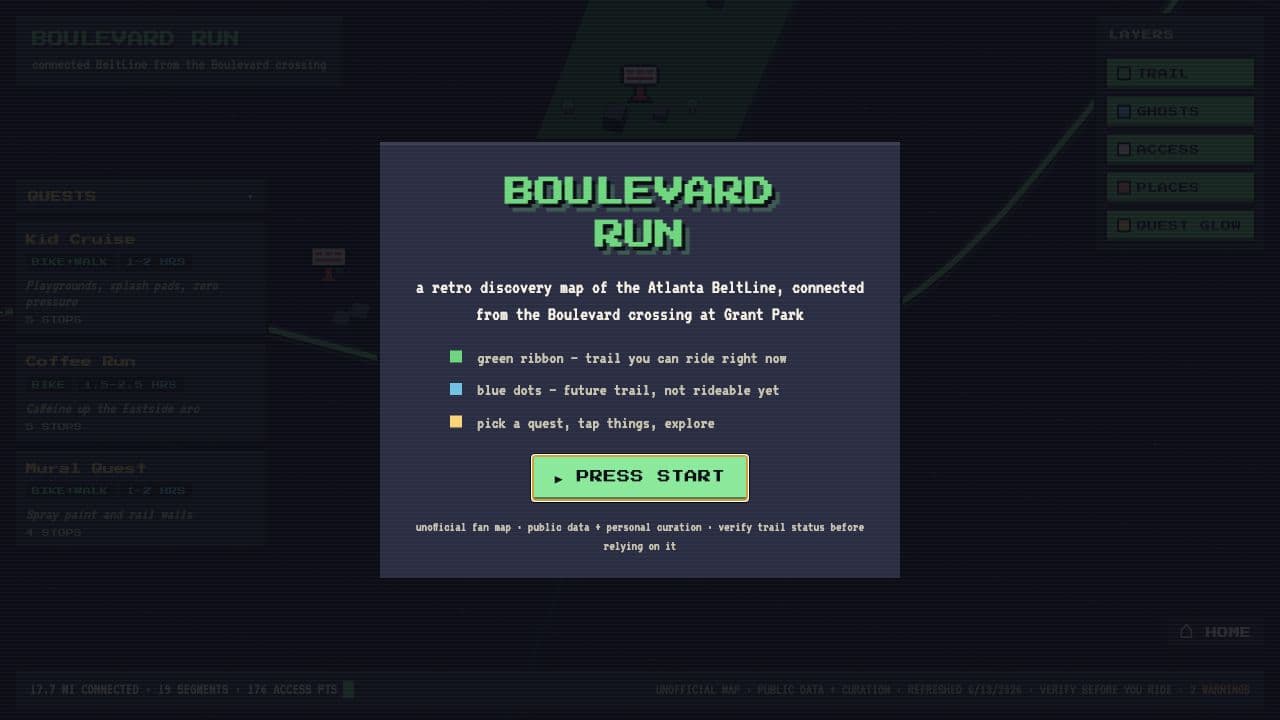
- Turns public trail geometry into a game-board style map centered on a real neighborhood start point.
- Computes connected trail segments from the Boulevard crossing instead of showing every segment as equally reachable.
- Uses curated quests and places to make the map feel like an invitation to go outside.
Why I Built It
Boulevard Run started from a very practical desire: I wanted a better way to understand what parts of the Atlanta BeltLine are actually connected from the public crossing near Boulevard and Grant Park.
Normal maps are good at showing where paths exist. They are less good at answering the question I actually had, which was closer to: if I start here with my family, what can we comfortably reach, and what would make the ride feel fun?
That made the project a nice fit for agentic coding. The shape of the idea was clear, but there were many details to push through: public GIS data, connectivity rules, map projection, visual style, place curation, and a front end that feels more like a small game than a civic data viewer.
How It Works
The app refreshes a committed data snapshot from public BeltLine trail and access-point services. A data script normalizes trail statuses, applies reviewed manual overrides, snaps endpoints, and walks the graph from the Boulevard home base to determine what is connected, disconnected, under construction, or future.
The front end renders that data as a stylized 3D scene. React Three Fiber and Three.js handle the trail ribbons, park islands, labels, and pixel-like markers. Turf.js helps with geometry work, and a development-only debug view can compare the computed state against a raw basemap.
The important product choice is that this is not an official GIS tool. It is a personal discovery map. The data gives it structure, but the map is trying to make nearby routes feel legible, playful, and worth trying.
What I Like About It
This is one of the clearest examples of what I like using coding agents for: a specific personal itch that crosses design, data, and implementation. The result is not just a demo of a library. It is a small piece of personal infrastructure for exploring a real place.